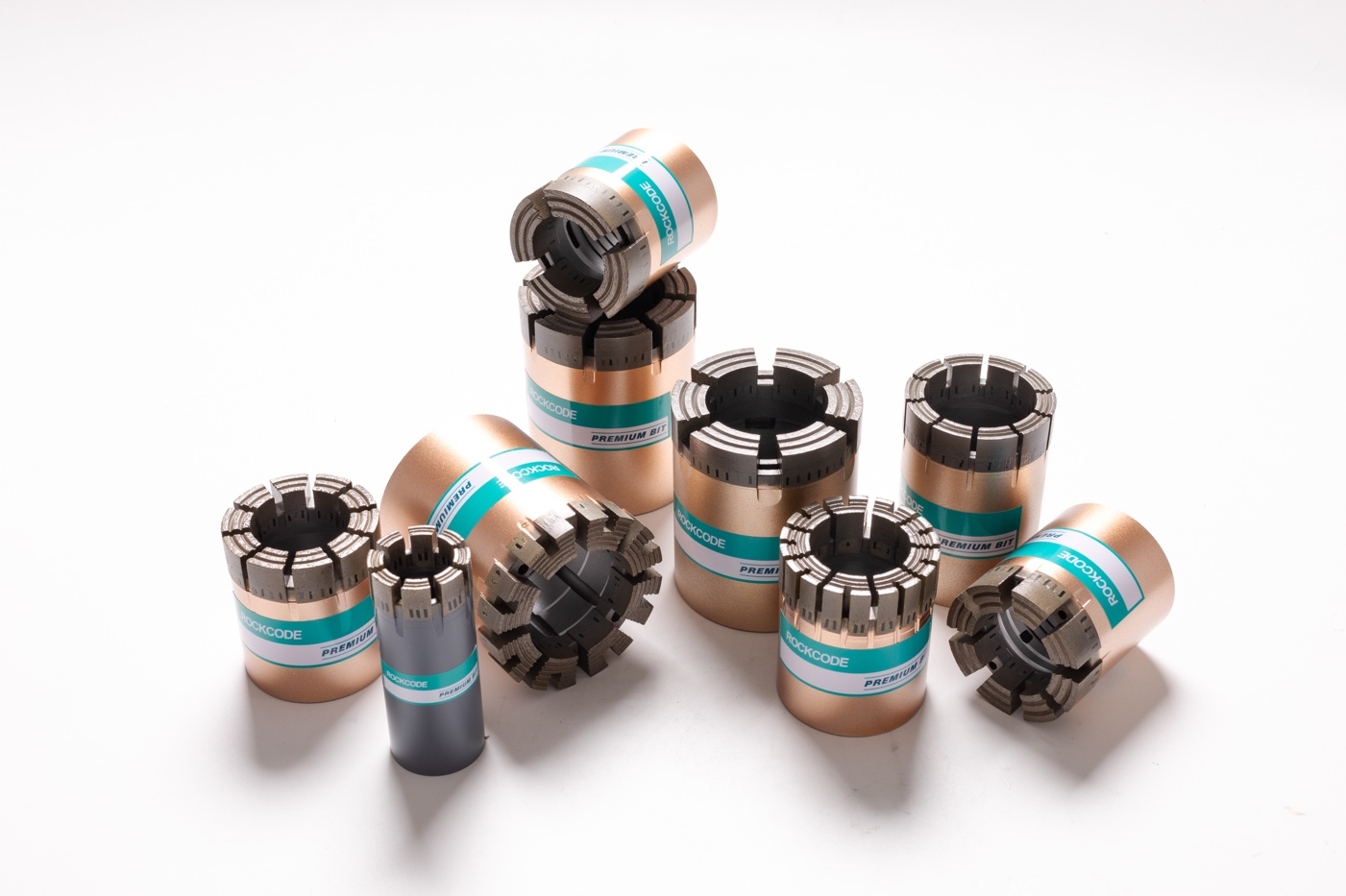
This note adapts legacy handbook guidance into a modern, engineer-facing reference for diamond core drilling [1]. Terminology is kept close to the sources where it carries meaning (e.g., mesh, stones per carat, gauge stones), with brief clarifications for today’s readers.
1) What an impregnated bit is made of
Impregnated bits are produced by combining screened fragmented diamond (bortz) with small whole diamonds, then mixing this diamond charge into a metal powder. The mixture is pressed and sintered into the cutting section.
Matrix (bond) system
-
A common matrix is based on tungsten carbide alloy systems, typically bonded with cobalt and additional metals that melt/flow at lower temperatures than tungsten carbide.
-
Legacy manufacturers also reported tungsten-alloy matrices containing secondary metals such as copper, nickel, zinc, etc., depending on the bond family and manufacturing route.
-
Cast-metal impregnated bits were historically described as being supplied primarily by special order rather than as a standard production route.
Engineering implication
-
In impregnated cutting sections, performance is governed by the interaction of:
diamond size, distribution, and protrusion, and matrix wear rate (ability to release and expose new cutting edges at the right pace).
2) Diamond size ranges and “gauge/kicker stones”
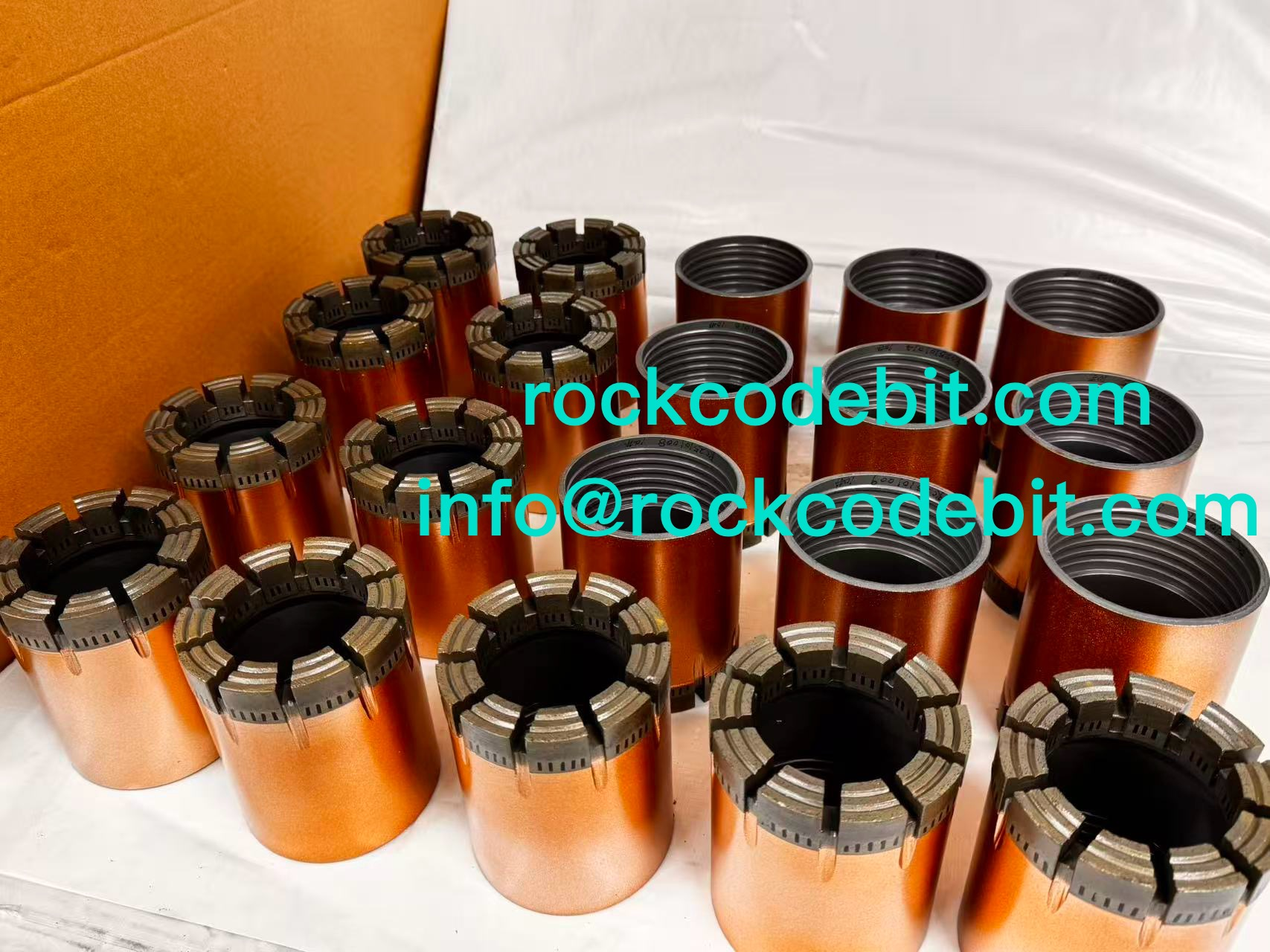
A broad range of diamond sizes has been used in impregnated bits. Legacy guidance describes a general range around 14–35 mesh, with many applications using diamond populations corresponding to >200 stones per carat (i.e., relatively small stones).
Gauge stones (kicker stones)
-
Some manufacturers place slightly larger stones on the inside and outside faces of the bit to act as gauge protection.
-
Other designs keep the same size everywhere or even reduce size at gauge.
-
The older literature explicitly notes there was no single predominant rule; gauge strategy depends on the intended wear mode and stability needs.
Formation-specific notes from the legacy text
-
For sandstone or sandy formations, some impregnated bits were made with relatively large particles (example cited: ~20 stones per carat).
-
A site-specific statement appears for hard iron ore (Soudan, Minnesota), where 30-mesh diamonds were reported as best for that case. Treat this as an historical datapoint, not a universal recommendation.
3) Cutting action in an impregnated bit: why “high speed / low pressure” shows up so often
In some impregnated systems (e.g., tungsten-carbide-based matrices), only a portion of diamonds may be prominently exposed at any moment. However, the overall cutting process can be understood as the cumulative effect of many small diamond particles producing numerous micro-scratches at the rock face.
Why excessive weight-on-bit can be counterproductive
Small individual diamond particles cannot tolerate the combined shearing/fracturing demands created by:
-
high bit pressure (weight-on-bit, WOB) plus
-
high rotational speed.
Because of this, the required diamond protrusion is small. If WOB is increased too far:
-
diamonds are forced deeper into the rock surface,
-
cuttings discharge can be impeded,
-
matrix wear can accelerate abnormally, and
-
diamonds can break away from the matrix.
Practical interpretation
The legacy text frames the operating “sweet spot” as a balance where rotational speed is maintained and WOB is limited so fine diamond cutting edges can work efficiently while cuttings are removed continuously.
4) Operating guidance: rotational speed and pressure
A representative recommendation in the handbook is:
-
impregnated bits should be used on high-speed machines,
-
with a minimum cited speed around 1500 rpm for EX size, and proportionally lower rpm for larger sizes,
-
using light pressure, and never so much pressure that the machine slows down.
The same source notes that some authorities specify lower speed and higher pressure than the quoted figures—highlighting that these values were not universal, even historically. The technical intent behind the guidance remains consistent:Maintain stable rpm; avoid “stalling” the cutting face.
If the rig cannot hold rpm under load, the cutting structure tends to transition from controlled micro-cutting into inefficient rubbing, regrinding, heat generation, and premature loss of diamonds.
5) Matrix wear versus diamond wear: controlled self-sharpening is the objective
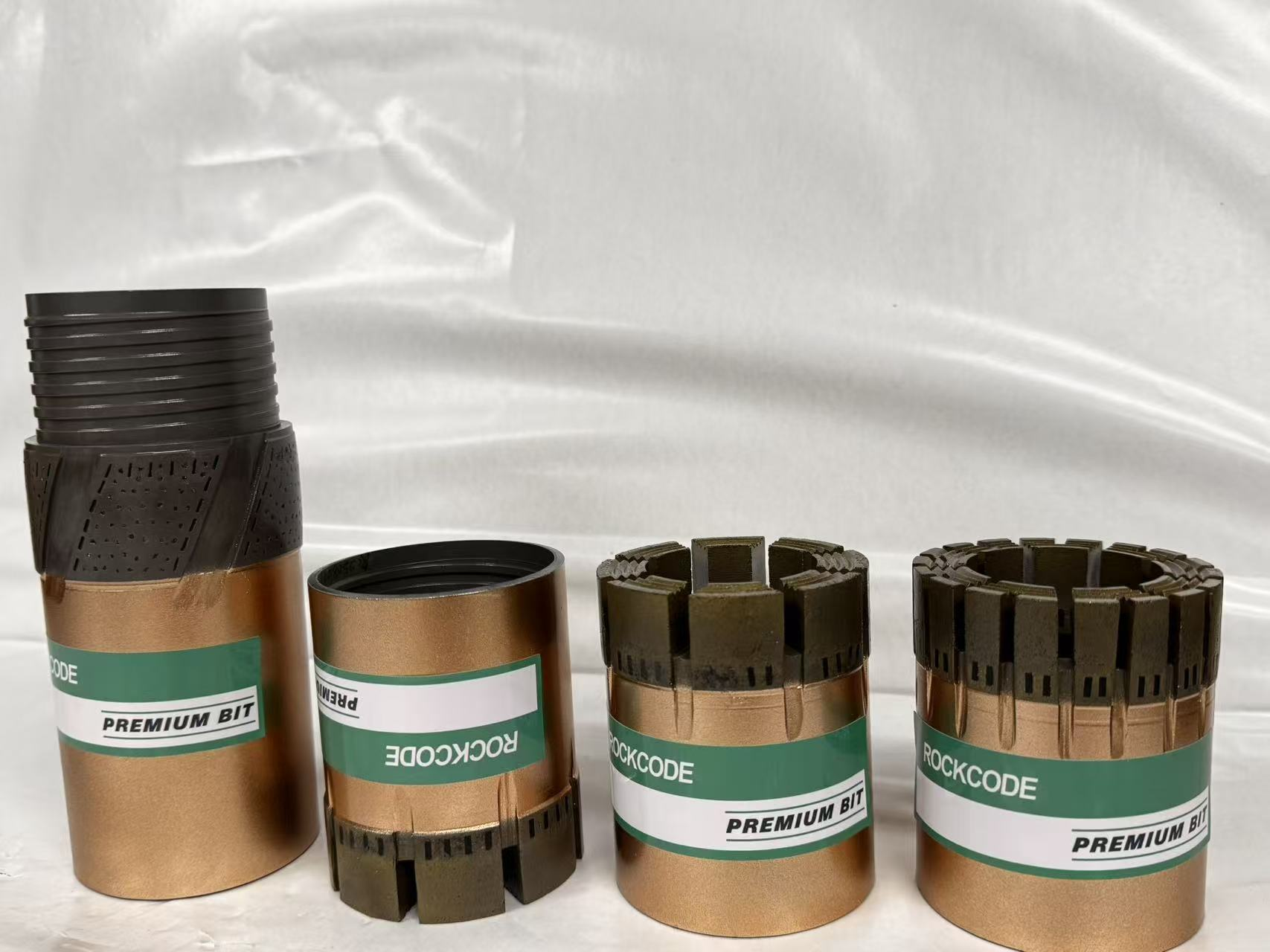
A recurring technical difficulty described in the legacy literature is achieving matrix wear that is proportional to diamond wear—so that new sharp diamond edges appear continuously. Progress in bond development was noted even in older sources; the underlying requirement is unchanged:
-
If the matrix is too hard (wears too slowly), diamonds remain buried or dulled and the bit “glazes.”
-
If the matrix is too soft (wears too quickly), diamonds are lost before their useful life is realized.
6) Conditioning and redressing: sand blasting as a practical method
For impregnated bits—particularly those bonded with tungsten carbide systems—the handbook emphasizes periodic sand blasting to expose fresh diamond cutting points.
-
Silicon carbide grit is mentioned as a blasting medium used to open the matrix and re-expose diamond.
-
The same practice is reported to have been used under certain underground drilling conditions to extend the usable life of whole-stone bits as well.
Modern equivalent interpretation
This is a bond-opening / face-conditioning method. The mechanism is straightforward: remove a thin layer of matrix at the cutting face to restore diamond protrusion and cutting aggressiveness.

7) Typical applications noted
The older text lists impregnated bits as adapted to:
-
coring in hard ground (including blast-hole coring contexts),
-
certain iron ores and iron formations,
-
impregnated casing bits or special fragmented-diamond bits used for gravel or overburden (sometimes described as more economical than whole-stone standard casing bits for that purpose).
It also records a practical observation on diamond recovery:
-
some users reclaim diamond particles from worn bits,
-
recovery was reported as typically less than ~25% of original diamond content, and many users do not attempt recovery at all.
→ For more information about ROCKCODE’s Products, please visit: https://www.rockcodebit.com/impregnated-diamond-core-bits
→ Email us at: info@rockcodebit.com
→ Information in this article is for general reference only. For specific drilling projects and drilling bits, please consult qualified professionals. Thank you.
Source
【1】Cumming, J. D. (1956). Diamond drill handbook. (2nd ed.). Smit.