
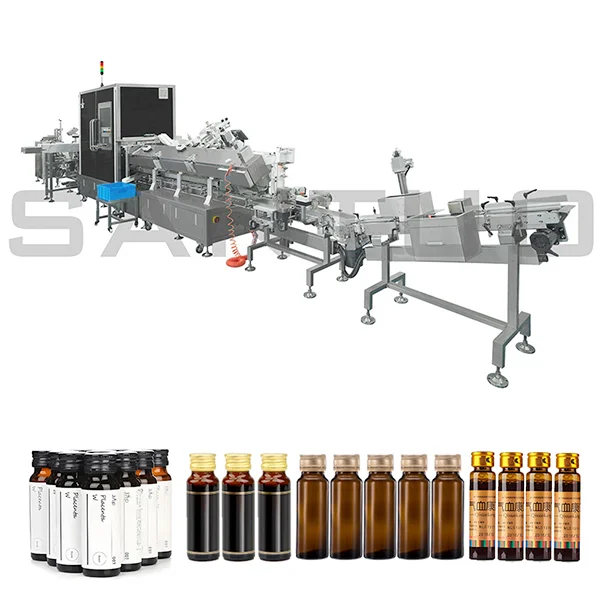
In the pharmaceutical industry, where precision and product integrity are paramount, automated inspection and labeling have become essential to ensuring consistent quality. The Oral Liquid Light Inspection and Labeling Machine integrates multiple functions — including light inspection, labeling, and tray loading — into one compact system. This integrated design helps pharmaceutical manufacturers improve inspection accuracy, maintain high throughput, and reduce manual intervention.
Comprehensive Visual and Functional Inspection
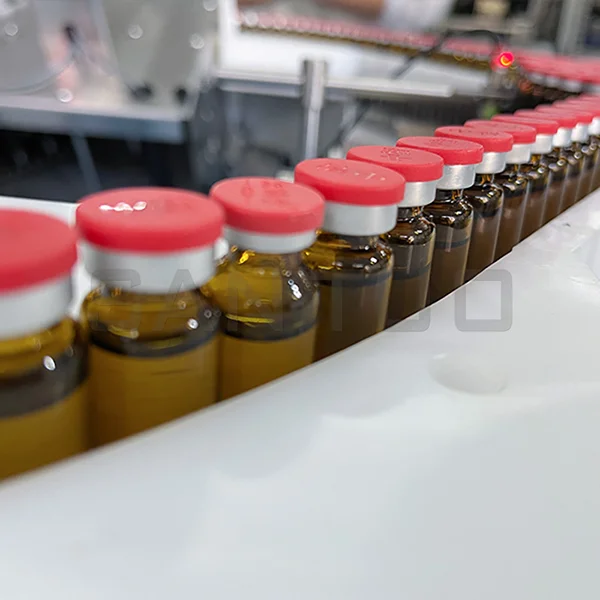
This system is primarily used for the automatic inspection of ampoule bottles, vials, oral liquid, and freeze-dried powder injection products. Through an advanced servo drive system, the machine achieves stable high-speed operation and precise image acquisition. This allows accurate detection of visible foreign particles, body defects, cap sealing issues, and even labeling quality — key factors for maintaining product safety and compliance with GMP standards.
Unlike traditional inspection systems, which may rely heavily on manual checks or single-angle vision systems, this equipment supports multi-angle, high-resolution image capture, ensuring comprehensive quality control without slowing down production.
Data-Driven Inspection and Traceability
One of the major technical advantages of the system lies in its intelligent software and database management. All inspection results can be stored, retrieved, and analyzed through built-in data management functions. The offline analysis capability allows quality teams to reproduce inspection processes and review anomalies after production, supporting continuous improvement and regulatory traceability.
This feature aligns with the growing demand for digitalized quality management systems in modern pharmaceutical manufacturing, helping enterprises transition toward smarter production lines.
High Precision Bottle Handling and Labeling
The equipment adopts a screw bottle separating mechanism to maintain precise spacing between bottles and reduce the risk of glass breakage. The horizontal roller chain conveyor provides consistent motion, improving inspection stability and labeling accuracy.
In addition, optional TTO or inkjet printing modules can print batch numbers, production dates, and expiry dates directly on the label during application, eliminating separate printing steps and simplifying process control.
Compact Design for Higher Efficiency
Traditional production setups often involve separate machines for inspection, labeling, and tray loading. The integrated design of this system minimizes equipment footprint while achieving seamless function transitions.
It features a high-performance automatic tray separating module that utilizes negative pressure suction for smooth bottle loading. This results in uniform tray arrangement and stable operation even at high speed — typically reducing labor demand by 1–2 operators compared with standalone equipment setups.
Moreover, because the labeling unit is directly connected to the inspection module, bottles are no longer re-fed through an additional screw mechanism, reducing the risk of surface scratches or secondary damage.
Benefits for Pharmaceutical Manufacturers
For pharmaceutical enterprises, the adoption of a fully integrated light inspection and labeling system offers several advantages:
-
Improved production continuity through automation and stable operation.
-
Enhanced inspection precision with non-contact optical methods.
-
Lower labor costs and reduced operator dependency.
-
Seamless integration into automated packaging lines, enabling true end-to-end production automation.
In today’s competitive environment, such equipment represents more than just a productivity upgrade — it’s a step toward achieving digital, intelligent, and compliant manufacturing in the pharmaceutical sector.