
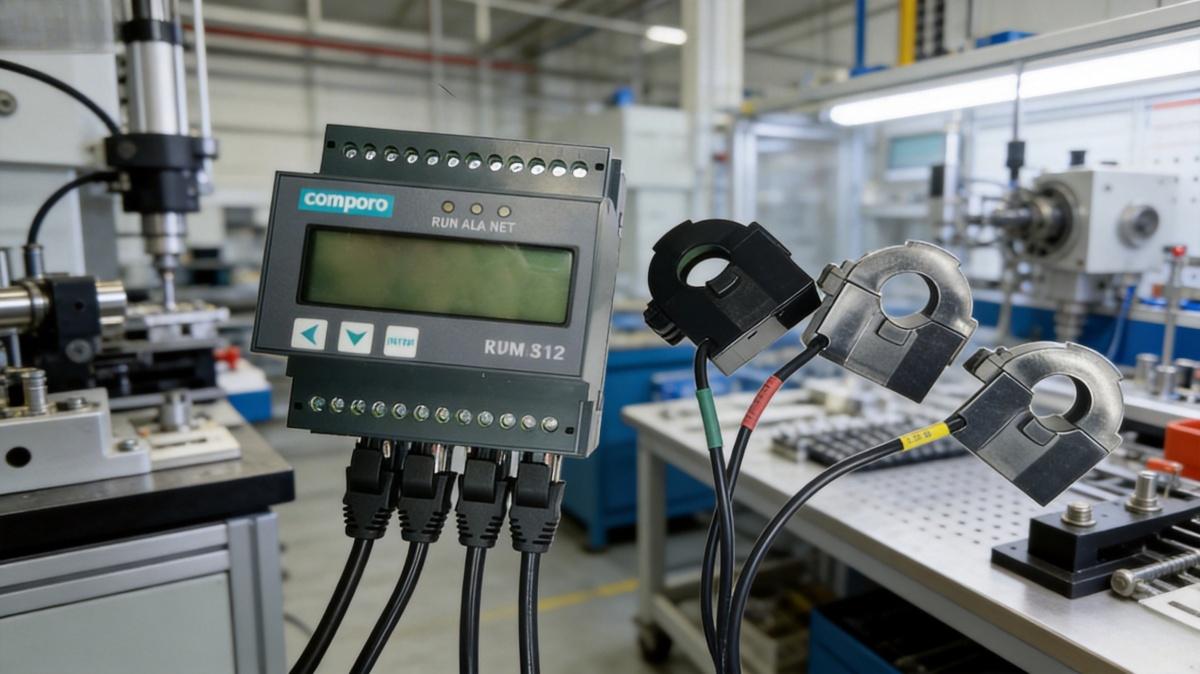
Driven by the deepening of "dual carbon" goals and the digital transformation of Industry 4.0, energy metering is no longer a simple electricity consumption statistic, but a core element for enterprises to reduce costs, increase efficiency, and achieve refined management. Traditional mechanical meters and manual meter reading are rapidly being replaced by smart meters with real-time communication and intelligent analysis capabilities.
For factories, industrial parks, and large commercial buildings, the flow of every kilowatt-hour of electricity is related to production costs and carbon emission targets. This article will delve into how smart energy meters can solve traditional metering problems in industrial applications and lead energy management into a new era.
The Pain Points of Industrial Metering: Invisible Waste and Uncontrolled Costs
In a case study of an auto parts factory in Suzhou, production managers were long troubled by a "muddled account": total electricity costs were consistently high, yet it was difficult to pinpoint which specific equipment was consuming abnormal power during non-production periods; equipment often lacked effective warnings before sudden tripping due to overload or three-phase imbalance, and each unplanned shutdown could result in tens or even hundreds of thousands of yuan in production losses. This is not an isolated case. Traditional industrial metering generally suffers from core pain points such as delayed data acquisition (manual meter reading is inefficient, with data lagging behind production by several days), weak anti-interference capabilities (data is easily distorted in strong industrial electromagnetic environments), and extensive management (only total electricity consumption is measured, unable to be allocated to specific production lines or processes). Faced with rising energy costs and stringent environmental reviews, enterprises urgently need an intelligent metering network that can penetrate deep into the equipment.
The "Core Weapon" of Smart Meters: From Precise Metering to Cloud-Based Insights Modern industrial-grade smart meters have long surpassed simple electricity accumulation functions. Taking mainstream IoT meters on the market as an example, their core advantages are mainly reflected in the following dimensions:
1. Millisecond-Level Precise Metering, Full-Parameter Sensing
High precision is the cornerstone of smart meters. Currently, advanced smart meters can achieve an energy accuracy of 0.5S, not only measuring active/reactive energy but also monitoring voltage, current, power factor, frequency, and harmonic components up to the 31st order in real time. This is crucial for precision manufacturing workshops, enabling timely warnings of power quality problems and protecting expensive equipment.
2. Flexible Networking to Solve Industrial Cabling Challenges
Industrial environments are complex, and production lines are frequently adjusted. Modern smart meters support multiple communication methods, including 4G, NB-IoT, WiFi, and LoRa.
Wireless Deployment: Utilizing open-type current transformers and magnet/piercing power extraction technology, no power outage modifications are required. Single-meter deployment time can be controlled within 15 minutes, significantly reducing downtime losses.
Strong Anti-Interference: Addressing signal attenuation issues in steel structure workshops, industrial-grade WiFi meters and CANbus meters, with their differential signal transmission and strong anti-interference capabilities, ensure stable data transmission in complex environments.
3. Edge Computing and Intelligent Diagnostics
Meters with edge computing capabilities can achieve "local intelligence." For example, they can remotely monitor phase sequence status and support adjustments, facilitating remote acceptance of construction quality; they also have anomaly alarm functions, proactively uploading alarm information when overvoltage, undercurrent, or wiring errors are detected.
In-depth Application Scenarios: From Equipment-Level Monitoring to Plant-Wide Energy Efficiency Optimization
The value of smart meters ultimately lies in their implementation across specific application scenarios. Through different deployment methods in the industrial field, they construct a comprehensive digital energy foundation.
Cenario 1: Independent "Check-up" for Critical Equipment
For high-energy-consuming equipment such as air compressors, chillers, and injection molding machines, by installing independent smart meters (such as the SDM series supporting CANbus communication), managers can view the instantaneous load and energy consumption per unit output of the equipment in real time. Once equipment efficiency declines (such as increased power consumption due to motor aging), the system immediately issues an alarm, guiding maintenance personnel to perform preventative maintenance.
Cenario 2: Centralized Management of Multiple Circuits and Areas
In logistics transfer stations or large power distribution cabinets, traditional solutions struggle to deploy a large number of single-circuit meters due to space constraints. Multi-circuit energy meters, with their modular design, can monitor up to 24 circuits in parallel within a limited space. This not only enables refined metering (such as distinguishing between lighting, air conditioning, and power consumption) but also provides remote on/off control functions, helping enterprises achieve on-demand electricity use and load management. Scenario 3: Enterprise-Level Energy Management Platform Integration
Smart energy meters are not only data collection endpoints but also execution terminals for management platforms. When smart meters are integrated with an enterprise energy management platform, the system can construct a five-level metering system encompassing the enterprise, workshop, production line, and equipment. Through big data analysis of the collected data, the platform can automatically generate energy efficiency benchmarking reports, identify abnormal energy consumption points, and even predict future load trends, providing a basis for enterprises to formulate scientific energy-saving strategies.
Future industrial smart meters will possess three major new features:
Bidirectional metering capability: Adaptable to scenarios such as photovoltaic energy storage and V2G charging piles, accurately capturing bidirectional power flow to meet the grid connection needs of new energy sources.
Proactive operation and maintenance mechanism: Predicting meter and front-end equipment failures through cloud data analysis, reducing fault handling time from hours to minutes.
Carbon data traceability: As the basic metering unit for carbon emission accounting, smart meters will directly provide first-hand data for enterprises' carbon asset management, supporting green manufacturing.
Conclusion
In today's world, with increasing energy costs and environmental pressures, every kilowatt-hour of electricity used in industrial production should not be wasted. Smart meters, as the "vanguard" of enterprise digital transformation, are helping companies move from extensive to intensive energy use through their accurate metering, real-time communication, and intelligent analysis. Whether building a new smart factory or upgrading older production lines for energy conservation, choosing a suitable smart meter solution is a crucial step in unlocking improved energy efficiency.